
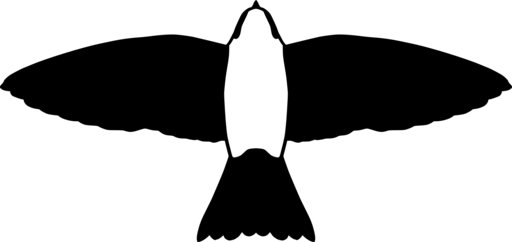
Blue-and-white Swallow
Notiochelidon cyanoleuca
Silhouette: Andy Wilson · PhyloPic
- KingdomAnimalia (Animals)
- PhylumChordata (Chordates)
- ClassAves (Birds)
- OrderPasseriformes (Perching Birds)
- FamilyHirundinidae (Swallows and Martins)
- GenusNotiochelidon
- SpeciesNotiochelidon cyanoleuca (Blue-and-white Swallow)
About the Blue-and-white Swallow
The blue-and-white swallow (Pygochelidon cyanoleuca) is a passerine bird that breeds from Nicaragua south throughout South America, except in the deserts and the Amazon Basin. The southern race is migratory, wintering as far north as Trinidad, where it is a regular visitor. The nominate northern race may have bred on that island.
The blue-and-white swallow was first formally described as Hirundo cyanoleuca by the French ornithologist Louis Pierre Vieillot in 1817, based on a specimen he believed to be from Paraguay. The scientific name has the same meaning as the English common name.
This species was formerly placed in the genus Notiochelidon. It was moved to the resurrected genus Pygochelidon based on a phylogenetic study published in 2005. Three subspecies are recognised: P. c. cyanoleuca (Vieillot, 1817) – Costa Rica through northern, central South America
P. c. peruviana Chapman, 1922 – western Peru P. c. patagonica (d'Orbigny & Lafresnaye, 1837) – southern South America The adult blue-and-white swallow averages 11–12 cm (4.3–4.7 in) long and weighs about 10 g (0.35 oz). It has dark blue upperparts and white underparts, and its underwings and the... Wikipedia →
Recent sightings of Blue-and-white Swallow in Amboró National Park
LIVEiNaturalistClosest Relatives at Amboró National Park

 Southern Martin
Progne elegans

 Southern Rough-winged Swallow
Stelgidopteryx ruficollis

 White-rumped Swallow
Tachycineta leucorrhoa

Tawny-headed Swallow
Alopochelidon fucata

Brown-chested Martin
Progne tapera

 Barn Swallow
Hirundo rustica

White-winged Swallow
Tachycineta albiventer

Gray-breasted Martin
Progne chalybea

Purple Martin
Progne subis

 Rufous-collared Sparrow
Zonotrichia capensis

 Southern House Wren
Troglodytes musculus

Golden-billed Saltator
Saltator aurantiirostris
Global Distribution
Warmer areas are where this animal is recorded most often.
Parks Where Found
Quick answers
What are the chances of seeing a Blue-and-white Swallow in Amboró National Park?
About 20% of wildlife watchers report a Blue-and-white Swallow sighting in Amboró National Park, based on 59 verified sightings from GBIF citizen-science data.
When is the best time to see Blue-and-white Swallow in Amboró National Park?
October has the highest sighting rate for Blue-and-white Swallow in Amboró National Park in our monthly data.