


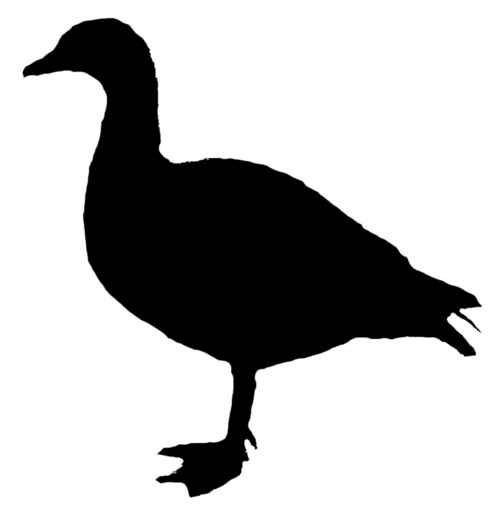
Egyptian Goose
Alopochen aegyptiaca
Silhouette: LordToran · PhyloPic
- KingdomAnimalia (Animals)
- PhylumChordata (Chordates)
- ClassAves (Birds)
- OrderAnseriformes (Waterfowl)
- FamilyAnatidae (Ducks, Geese, and Swans)
- GenusAlopochen (African and Mascarene Sheldgeese)
- SpeciesAlopochen aegyptiaca (Egyptian Goose)
About the Egyptian Goose
The Egyptian goose (Alopochen aegyptiaca) is an African member of the Anatidae family including ducks, geese, and swans. Because of its popularity chiefly as an ornamental bird, the species has also been introduced to Europe, the United States, and elsewhere outside its natural range. Egyptian geese were regularly represented in ancient Egyptian art.
The Egyptian goose was formally described in 1766 by Swedish naturalist Carl Linnaeus in the 12th edition of his Systema Naturae under the binomial name Anas aegyptiaca. Linnaeus partly based his account on the L'oye d'Egypte that had been described and illustrated in 1760 by French ornithologist Mathurin Jacques Brisson in his Ornithologie. Brisson used the Latin name Anser Egyptiatiacus, and although he coined Latin names for species, these do not conform to the binomial system and are not recognised by the International Commission on Zoological Nomenclature. The Egyptian goose is now placed with the extinct Mauritius sheldgoose and the extinct Reunion sheldgoose in the genus Alopochen that was introduced in 1885 by Norwegian-born zoologist Leonhard Stejneger. The species is monotypic; no subspecies are recognised. The... Wikipedia →
Recent sightings of Egyptian Goose in Biebrza National Park
LIVEiNaturalistClosest Relatives at Biebrza National Park

 Mallard
Anas platyrhynchos

 Greylag Goose
Anser anser

 Mute Swan
Cygnus olor

 Eurasian Wigeon
Mareca penelope

Garganey
Spatula querquedula

 Northern Shoveler
Spatula clypeata

Common Teal
Anas crecca

 Gadwall
Mareca strepera

 Common Goldeneye
Bucephala clangula

 Whooper Swan
Cygnus cygnus

 Greater White-fronted Goose
Anser albifrons

Northern Pintail
Anas acuta
Global Distribution
Warmer areas are where this animal is recorded most often.