



Chicken Snake
Spilotes pullatus
Silhouette: Alex Slavenko · PhyloPic
- KingdomAnimalia (Animals)
- PhylumChordata (Chordates)
- ClassSquamata
- FamilyColubridae (Colubrid Snakes)
- GenusSpilotes
- SpeciesSpilotes pullatus (Chicken Snake)
About the Chicken Snake
Spilotes pullatus, commonly known as the chicken snake, tropical chicken snake, yellow rat snake, or tiger rat snake is a species of large nonvenomous colubrid snake endemic to the Neotropics. Including the nominotypical subspecies, the following five subspecies are recognized:
S. p. pullatus (Linnaeus, 1758) S. p. anomalepis Bocourt, 1888 S. p. argusiformis Amaral, 1929 S. p. maculatus Amaral, 1929 S. p. mexicanus (Laurenti, 1768) It is found in southern Mexico, Central America, northern and central South America, and Trinidad and Tobago in the Caribbean.
Adults may attain a maximum total length of 2.7 m (8.9 ft), with the average length ranging from 1.5 to 2 m (4.9 to 6.6 ft). Dorsally, S. pullatus is black with yellow spots which may form crossbands. The tip of the snout is yellow. The head shields may be mostly yellow, or mostly black, or crossbanded with a combination of yellow and black, but the sutures between the shields are always black. Ventrally, it is yellow with irregular black crossbands.
The body is relatively slender and somewhat laterally compressed. The head is distinct from the neck. The eye... Wikipedia →
Recent sightings of Chicken Snake in Pico Bonito National Park
LIVEiNaturalistClosest Relatives at Pico Bonito National Park

 Blunthead Tree Snake
Imantodes cenchoa

 Red Coffee Snake
Ninia sebae

 Northern Cat-eyed Snake
Leptodeira septentrionalis

Yellowbelly Snake
Coniophanes fissidens

Ecuador Sipo
Chironius grandisquamis

Mexican Parrot Snake
Leptophis mexicanus

Black-striped Snake
Coniophanes imperialis
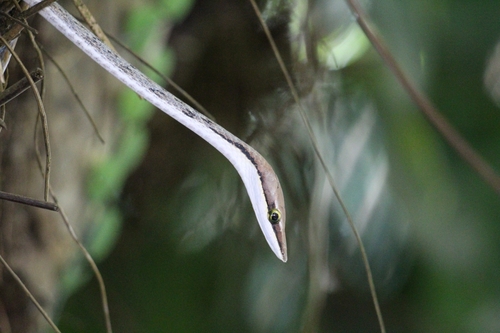
Köhler’s Vine Snake
Oxybelis koehleri

Rhadinella anachoreta
Rhadinella anachoreta

South American Forest Racer
Dendrophidion percarinatum
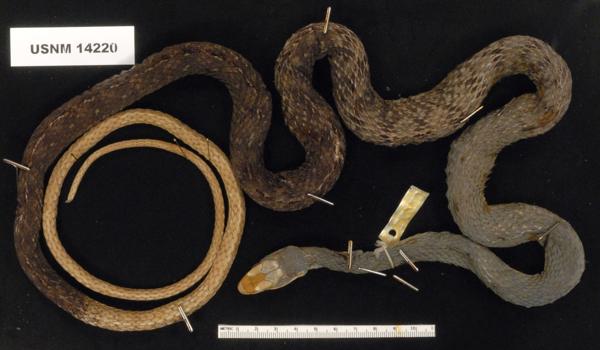
Red-headed Forest Racer
Dendrophidion rufiterminorum

Yellow-red Rat Snake
Pseudelaphe flavirufa
Global Distribution
Warmer areas are where this animal is recorded most often.