


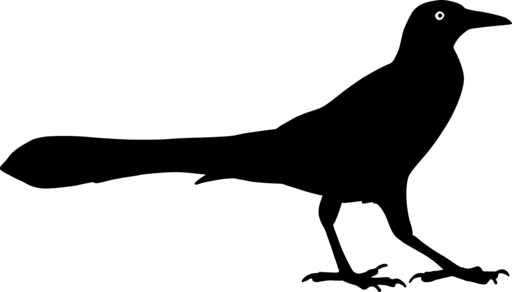
Great-tailed Grackle
Quiscalus mexicanus
Silhouette: Andy Wilson · PhyloPic
- KingdomAnimalia (Animals)
- PhylumChordata (Chordates)
- ClassAves (Birds)
- OrderPasseriformes (Perching Birds)
- FamilyIcteridae (New World Blackbirds and Orioles)
- GenusQuiscalus (Typical Grackles)
- SpeciesQuiscalus mexicanus (Great-tailed Grackle)
About the Great-tailed Grackle
The great-tailed grackle or Mexican grackle (Quiscalus mexicanus) is a medium-sized, highly social passerine bird native to North and South America. A member of the family Icteridae, it is one of 10 extant species of grackle and is closely related to the boat-tailed grackle and the extinct slender-billed grackle. In the southern and southwestern United States, the grackle is sometimes referred to simply as a "blackbird" or (erroneously) a "crow" due to its glossy black plumage; however, grackles form their own unique genus that is separate from other "blackbirds", such as the red-winged and Brewer's blackbirds, despite being in the same family (Icteridae). Superficially, Brewer's blackbird is one of the most visually similar species to grackles.
In some parts of Mexico, the grackle is sometimes referred to in Spanish as cuervo ("raven"; "crow"), although it is not a member of the crow genus (Corvus) nor of their family (Corvidae). The great-tailed grackle was formally described in 1788 by the German naturalist Johann Friedrich Gmelin in his revised and expanded edition of Carl Linnaeus's Systema Naturae. He placed it with the crows in the genus Corvus and coined the... Wikipedia →
Recent sightings of Great-tailed Grackle in Corcovado National Park
LIVEiNaturalistClosest Relatives at Corcovado National Park

 Scarlet-rumped Cacique
Cacicus uropygialis

 Baltimore Oriole
Icterus galbula

Melodious Blackbird
Dives dives

Red-breasted Blackbird
Sturnella militaris

 Bronzed Cowbird
Molothrus aeneus

Yellow-billed Cacique
Amblycercus holosericeus

Shiny Cowbird
Molothrus bonariensis

Eastern Meadowlark
Sturnella magna

Montezuma Oropendola
Psarocolius montezuma

Giant Cowbird
Molothrus oryzivorus

Orchard Oriole
Icterus spurius

Chestnut-headed Oropendola
Psarocolius wagleri
Global Distribution
Warmer areas are where this animal is recorded most often.
Parks Where Found
Quick answers
What are the chances of seeing a Great-tailed Grackle in Corcovado National Park?
About 20% of wildlife watchers report a Great-tailed Grackle sighting in Corcovado National Park, based on 586 verified sightings from GBIF citizen-science data.
When is the best time to see Great-tailed Grackle in Corcovado National Park?
June has the highest sighting rate for Great-tailed Grackle in Corcovado National Park in our monthly data.