



Crane Hawk
Geranospiza caerulescens
Silhouette: Sheatherius · PhyloPic
- KingdomAnimalia (Animals)
- PhylumChordata (Chordates)
- ClassAves (Birds)
- OrderAccipitriformes (Hawks, Eagles, Kites, and Allies)
- FamilyAccipitridae (Hawks, Eagles, and Kites)
- GenusGeranospiza
- SpeciesGeranospiza caerulescens (Crane Hawk)
About the Crane Hawk
The crane hawk (Geranospiza caerulescens) is a species of bird of prey in the family Accipitridae. It is the only species placed in the genus Geranospiza. The crane hawk used to be many species that were recently lumped into one. Those species are now designated as subspecies. Color varies clinally, though, and it is now commonly accepted that they comprise one species. There are also two species of harrier-hawks in Africa of the genus Polyboroides that, while they are morphologically and behaviorally similar, are not very closely related. They serve as a good example of convergent evolution.
Six subspecies are recognised: G. c. livens Bangs & Penard, TE, 1921 – northwest Mexico G. c. nigra (Du Bus de Gisignies, 1847) – Mexico to central Panama G. c. balzarensis Sclater, WL, 1918 – east Panama to northwest Peru
G. c. caerulescens (Vieillot, 1817) – east Colombia to the Guianas to east Peru and Amazonian Brazil G. c. gracilis (Temminck, 1821) – northeast Brazil G. c. flexipes Peters, JL, 1935 – south Brazil to Paraguay, Bolivia, north Argentina and Uruguay
Crane hawks occur in tropical lowlands at the edge of forests and are almost always... Wikipedia →
Recent sightings of Crane Hawk in Emas National Park
LIVEiNaturalistClosest Relatives at Emas National Park
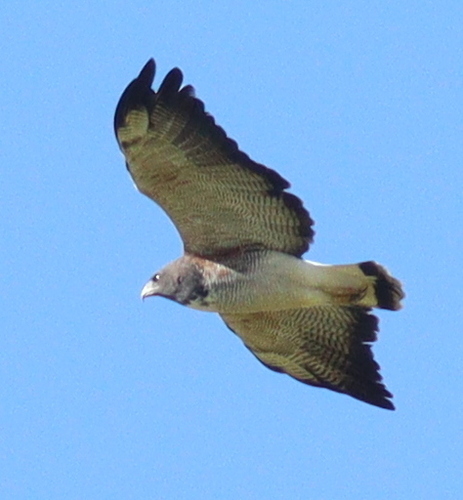
 White-tailed Hawk
Buteo albicaudatus

 Savanna Hawk
Buteogallus meridionalis

 Roadside Hawk
Rupornis magnirostris

 American Swallow-tailed Kite
Elanoides forficatus

 Long-winged Harrier
Circus buffoni

 White-tailed Kite
Elanus leucurus

 Plumbeous Kite
Ictinia plumbea

Hook-billed Kite
Chondrohierax uncinatus

Chaco Eagle
Harpyhaliaetus coronatus

Short-tailed Hawk
Buteo brachyurus

Black-and-white Hawk-Eagle
Spizaetus melanoleucus

 Gray-headed Kite
Leptodon cayanensis
Global Distribution
Warmer areas are where this animal is recorded most often.
Parks Where Found
Quick answers
What are the chances of seeing a Crane Hawk in Emas National Park?
Under 5% of wildlife watchers report a Crane Hawk sighting in Emas National Park, based on 6 verified sightings from GBIF citizen-science data.
When is the best time to see Crane Hawk in Emas National Park?
July has the highest sighting rate for Crane Hawk in Emas National Park in our monthly data.