


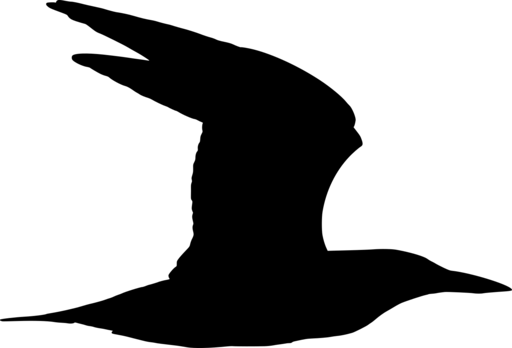
Caspian Tern
Hydroprogne caspia
Silhouette: Andy Wilson · PhyloPic
- KingdomAnimalia (Animals)
- PhylumChordata (Chordates)
- ClassAves (Birds)
- OrderCharadriiformes (Shorebirds and Allies)
- FamilyLaridae (Gulls, Terns, and Skimmers)
- GenusHydroprogne (Caspian Terns)
- SpeciesHydroprogne caspia (Caspian Tern)
About the Caspian Tern
The Caspian tern (Hydroprogne caspia) is the world's largest species of tern, with a subcosmopolitan but scattered distribution. Despite its extensive range, it is monotypic of its genus, and has no accepted subspecies. The genus name is from Ancient Greek hudro-, "water-", and Latin progne, "swallow". The specific caspia is from Latin and, like the English name, refers to the Caspian Sea.
It is the world's largest tern with a length of 48–60 cm (19–24 in), a wingspan of 127–145 cm (50–57 in) and a weight of 530–782 g (18.7–27.6 oz). Adult birds have black legs, and a long thick red-orange bill with a small black tip. They have a white head with a black cap and white neck, belly, and tail. The upper wings and back are pale grey; the underwings are pale with dark primary feathers. In-flight, the tail is less forked than other terns, and wingtips are black on the underside. In winter, the black cap is still present (unlike many other terns), but with some white streaking on the forehead. The call is a loud heron-like croak.
Their breeding habitat is large lakes and ocean coasts in North America (including the Great Lakes), and locally in... Wikipedia →
Recent sightings of Caspian Tern in Hwange National Park
LIVEiNaturalistClosest Relatives at Hwange National Park

 Whiskered Tern
Chlidonias hybrida

White-winged Tern
Chlidonias leucopterus

 African Skimmer
Rynchops flavirostris

 Grey-hooded Gull
Chroicocephalus cirrocephalus

 Blacksmith Lapwing
Vanellus armatus

 Black-winged Stilt
Himantopus himantopus

Crowned Lapwing
Vanellus coronatus

 African Jacana
Actophilornis africanus

 Wood Sandpiper
Tringa glareola

 Common Sandpiper
Actitis hypoleucos

Common Greenshank
Tringa nebularia

 Water Thick-knee
Burhinus vermiculatus
Global Distribution
Warmer areas are where this animal is recorded most often.