

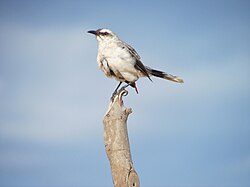



Tropical Mockingbird
Mimus gilvus
Silhouette: Anna Delesmillieres, Titouan Montessuit · PhyloPic
- KingdomAnimalia (Animals)
- PhylumChordata (Chordates)
- ClassAves (Birds)
- OrderPasseriformes (Perching Birds)
- FamilyMimidae (Mockingbirds and Thrashers)
- GenusMimus (Typical Mockingbirds)
- SpeciesMimus gilvus (Tropical Mockingbird)
About the Tropical Mockingbird
The tropical mockingbird (Mimus gilvus) is a resident breeding bird from southern Mexico to northern and eastern South America and in the Lesser Antilles and other Caribbean islands. The tropical mockingbird has sometimes been considered conspecific with its closest living relative, the northern mockingbird (Milvus polyglottos) and forms a superspecies with it. The critically endangered Socorro mockingbird (M. graysoni) is also much closer to these two than previously believed.
The tropical mockingbird has these ten subspecies: M. g. gracilis Cabanis, 1851 M. g. leucophaeus Ridgway, 1888 M. g. antillarum Hellmayr & Seilern, 1915 M. g. tobagensis Dalmas, 1900 M. g. rostratus Ridgway, 1884 M. g. melanopterus Lawrence, 1849
M. g. gilvus (Vieillot, 1808) M. g. tolimensis Ridgway, 1904 M. g. antelius Oberholser, 1919 M. g. magnirostris Cory, 1887 M. g. antelius and M. g. magnirostris have been suggested as separate species but morphological and vocal evidence for the potential splits are weak.
Adult tropical mockingbirds are 23 to 25.5 cm (9.1 to 10.0 in) long. The mean weights of various subspecies vary greatly. Adults of the nominate subspecies... Wikipedia →
Recent sightings of Tropical Mockingbird in Puracé National Natural Park
LIVEiNaturalistClosest Relatives at Puracé National Natural Park

 Rufous-collared Sparrow
Zonotrichia capensis

 Green Jay
Cyanocorax yncas

 Tropical Kingbird
Tyrannus melancholicus

 Great Thrush
Turdus fuscater

 Blackburnian Warbler
Setophaga fusca

Blue-gray Tanager
Thraupis episcopus

Black-billed Thrush
Turdus ignobilis

 Slate-throated Redstart
Myioborus miniatus

 Yellow-backed Oriole
Icterus chrysater

 Blue-and-white Swallow
Notiochelidon cyanoleuca

Scrub Tanager
Stilpnia vitriolina

Blue-necked Tanager
Stilpnia cyanicollis
Global Distribution
Warmer areas are where this animal is recorded most often.
Parks Where Found
Quick answers
What are the chances of seeing a Tropical Mockingbird in Puracé National Natural Park?
About 20% of wildlife watchers report a Tropical Mockingbird sighting in Puracé National Natural Park, based on 182 verified sightings from GBIF citizen-science data.
When is the best time to see Tropical Mockingbird in Puracé National Natural Park?
August has the highest sighting rate for Tropical Mockingbird in Puracé National Natural Park in our monthly data.