


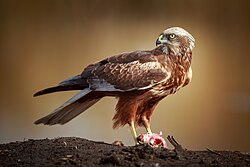


Western Marsh-Harrier
Circus aeruginosus
Silhouette: Mathieu Pélissié · PhyloPic
- KingdomAnimalia (Animals)
- PhylumChordata (Chordates)
- ClassAves (Birds)
- OrderAccipitriformes (Hawks, Eagles, Kites, and Allies)
- FamilyAccipitridae (Hawks, Eagles, and Kites)
- GenusCircus (Harriers)
- SpeciesCircus aeruginosus (Western Marsh-Harrier)
About the Western Marsh-Harrier
The western marsh harrier (Circus aeruginosus) is a large harrier, a bird of prey from temperate and subtropical western Eurasia and adjacent Africa. It is also known as the Eurasian marsh harrier. Formerly, a number of relatives were included in C. aeruginosus, which was then known as "marsh harrier". The related taxa are now generally considered to be separate species: the eastern marsh harrier (C. spilonotus), the Papuan harrier (C. spilothorax) of eastern Asia and the Wallacea, the swamp harrier (C. approximans) of Australasia and the Madagascar marsh harrier (C. maillardi) of the western Indian Ocean islands.
The western marsh harrier is often divided into two subspecies, the widely migratory C. a. aeruginosus which is found across most of its range, and C. a. harterti which is resident all-year in north-west Africa. The western marsh harrier was scientifically described by Carl Linnaeus in 1758 in the tenth edition of his Systema Naturae under the binomial name Falco aeruginosus. Linnaeus specified the locality as Europe but restricted this to Sweden in 1761. The western marsh harrier is now placed in the genus Circus that was introduced by Bernard Germain de Lacépède... Wikipedia →
Recent sightings of Western Marsh-Harrier in Pyrénées National Park
LIVEiNaturalistClosest Relatives at Pyrénées National Park

 Hen Harrier
Circus cyaneus

 Montagu's Harrier
Circus pygargus

 Pale Harrier
Circus macrourus

 Griffon Vulture
Gyps fulvus

 Red Kite
Milvus milvus

 Common Buzzard
Buteo buteo

 Bearded Vulture
Gypaetus barbatus

 Black Kite
Milvus migrans

 Egyptian Vulture
Neophron percnopterus

 Short-toed Eagle
Circaetus gallicus

 Booted Eagle
Hieraaetus pennatus

 Golden Eagle
Aquila chrysaetos
Global Distribution
Warmer areas are where this animal is recorded most often.
Parks Where Found
Quick answers
What are the chances of seeing a Western Marsh-Harrier in Pyrénées National Park?
About 10% of wildlife watchers report a Western Marsh-Harrier sighting in Pyrénées National Park, based on 753 verified sightings from GBIF citizen-science data.
When is the best time to see Western Marsh-Harrier in Pyrénées National Park?
January has the highest sighting rate for Western Marsh-Harrier in Pyrénées National Park in our monthly data.