



White-faced Whistling Duck
Dendrocygna viduata
Silhouette: Kai Caspar · PhyloPic
- KingdomAnimalia (Animals)
- PhylumChordata (Chordates)
- ClassAves (Birds)
- OrderAnseriformes (Waterfowl)
- FamilyAnatidae (Ducks, Geese, and Swans)
- GenusDendrocygna (Whistling-Ducks)
- SpeciesDendrocygna viduata (White-faced Whistling Duck)
About the White-faced Whistling Duck
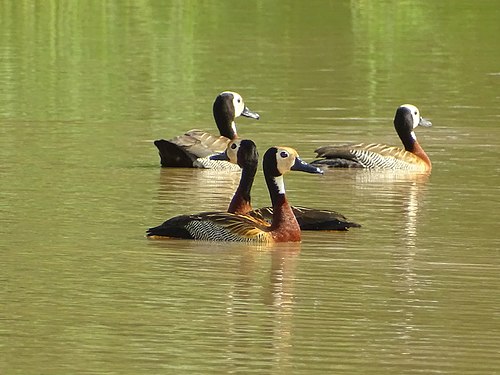
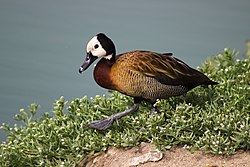
The white-faced whistling duck (Dendrocygna viduata) is a whistling duck that breeds in sub-Saharan Africa and much of South America. This species is gregarious, and at favoured sites, the flocks of a thousand or more birds arriving at dawn are an impressive sight. As the name implies, these are noisy birds with a clear three-note whistling call.
The white-faced whistling duck was formally described by the Swedish naturalist Carl Linnaeus in the 1766 twelfth edition of his Systema Naturae, under the binomial name Anas viduata. He specified the type locality as Cartagena in Colombia. The white-faced whistling duck is now one of eight species placed in the genus Dendrocygna that was introduced in 1837 by the English naturalist William Swainson. The species is considered as monotypic: no subspecies are recognised. The genus name combines the Ancient Greek dendron, meaning "tree", with the genus name Cygnus, meaning "swan" in Latin. The specific epithet viduata is Latin and means "widowed" or "in mourning".
The white-faced whistling duck has a long grey bill, a long head, and longish legs. It has a black neck and head, and a distinctive white face that... Wikipedia →
Recent sightings of White-faced Whistling Duck in Queen Elizabeth National Park
LIVEiNaturalistClosest Relatives at Queen Elizabeth National Park

 Fulvous Whistling-Duck
Dendrocygna bicolor

 Egyptian Goose
Alopochen aegyptiaca

African Black Duck
Anas sparsa

Comb Duck
Sarkidiornis melanotos

Yellow-billed Duck
Anas undulata

Hottentot Teal
Spatula hottentota

Spur-winged Goose
Plectropterus gambensis

Red-billed Teal
Anas erythrorhyncha

African Pygmy-Goose
Nettapus auritus

Garganey
Spatula querquedula

White-backed Duck
Thalassornis leuconotus
Global Distribution
Warmer areas are where this animal is recorded most often.
Parks Where Found
Quick answers
What are the chances of seeing a White-faced Whistling Duck in Queen Elizabeth National Park?
About 10% of wildlife watchers report a White-faced Whistling Duck sighting in Queen Elizabeth National Park, based on 105 verified sightings from GBIF citizen-science data.
When is the best time to see White-faced Whistling Duck in Queen Elizabeth National Park?
December has the highest sighting rate for White-faced Whistling Duck in Queen Elizabeth National Park in our monthly data.