


Black Phoebe
Sayornis nigricans
- KingdomAnimalia (Animals)
- PhylumChordata (Chordates)
- ClassAves (Birds)
- OrderPasseriformes (Perching Birds)
- FamilyTyrannidae (Tyrant Flycatchers)
- GenusSayornis (Phoebes)
- SpeciesSayornis nigricans (Black Phoebe)
About the Black Phoebe
The black phoebe (Sayornis nigricans) is a passerine bird in the tyrant-flycatcher family. It breeds from southwest Oregon and California south through Central and South America. It occurs year-round throughout most of its range and migrates less than the other birds in its genus though its northern populations are partially migratory. Six subspecies are commonly recognized although two are occasionally combined as a separate species, the white-winged phoebe.
The black phoebe has predominantly black plumage, with a white belly and undertail coverts. The sexes are identical in color, and juveniles have brown feather tips and brown wing-bars. Its song is a repeated tee-hee, tee ho. It lives in a variety of habitats but is always near water. It is mainly insectivorous and waits on a perch before sallying out and catching its prey in the air. It makes an open cup nest which is placed under a cliff or a bridge and cemented in its place with mud.
The black phoebe is a medium-sized flycatcher, being 16 cm (6.3 in) in length and weighing 15 to 22 g (0.5 to 0.8 oz). It has predominantly black plumage, with white on its belly and undertail coverts. The white forms an inverted... Wikipedia →
Closest Relatives at Saguaro National Park

Say's Phoebe
Sayornis saya
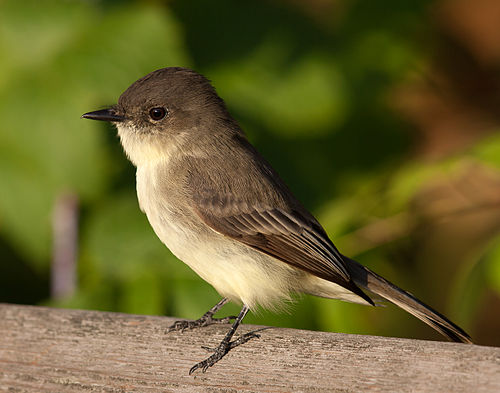
Eastern Phoebe
Sayornis phoebe

Vermilion Flycatcher
Pyrocephalus rubinus

Brown-crested Flycatcher
Myiarchus tyrannulus

Ash-throated Flycatcher
Myiarchus cinerascens

Cassin's Kingbird
Tyrannus vociferans

Western Kingbird
Tyrannus verticalis

Tropical Kingbird
Tyrannus melancholicus

Western Wood-Pewee
Contopus sordidulus

Pacific-slope Flycatcher
Empidonax difficilis

Gray Flycatcher
Empidonax wrightii

Greater Pewee
Contopus pertinax
Global Distribution
Where this species is recorded worldwide. Restricted to human observations from 2019 onwards — the same kind of record and the same period the probabilities on this page are built from, so collar-tracking studies, camera-trap arrays and museum specimens are excluded. Around Santa Rosa that removes 5,924 GPS fixes from a handful of tagged jaguars.
where this species is recorded (GBIF density — it tracks where observers go, not how likely a sighting is) · parks where it occurs — tap a pin for the sighting probability there
Parks Where Found
Quick answers
What are the chances of seeing a Black Phoebe in Saguaro National Park?
About 20% of wildlife watchers report a Black Phoebe sighting in Saguaro National Park, based on 11,977 verified sightings from GBIF citizen-science data.
When is the best time to see Black Phoebe in Saguaro National Park?
November has the highest sighting rate for Black Phoebe in Saguaro National Park in our monthly data.