


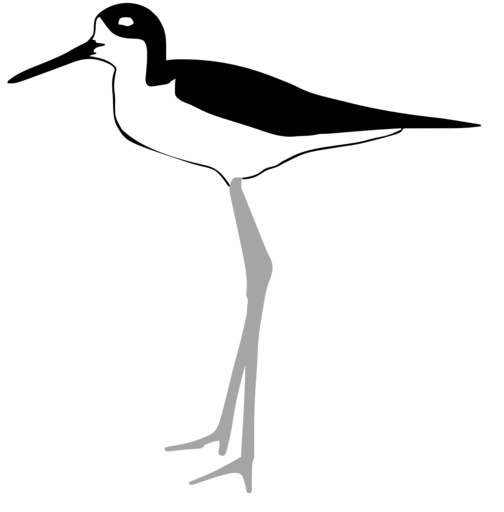
Black-necked Stilt
Himantopus mexicanus
Silhouette: Edwin Price · PhyloPic
- KingdomAnimalia (Animals)
- PhylumChordata (Chordates)
- ClassAves (Birds)
- OrderCharadriiformes (Shorebirds and Allies)
- FamilyRecurvirostridae (Stilts and Avocets)
- GenusHimantopus (Typical Stilts)
- SpeciesHimantopus mexicanus (Black-necked Stilt)
About the Black-necked Stilt
The black-necked stilt (Himantopus mexicanus), also called the pied stilt, is a locally abundant shorebird of North and South American wetlands and coastlines. It is found from the coastal areas of California through much of the interior western United States and along the Gulf of Mexico as far east as Florida, then south through Central America and the Caribbean to Brazil, Peru and the Galápagos Islands, with an isolated population, the Hawaiian stilt, in Hawaii. The northernmost populations, particularly those from inland, are migratory, wintering from the extreme south of the United States to southern Mexico, rarely as far south as Costa Rica; on the Baja California peninsula it is only found regularly in winter. Some authorities, including the IUCN, treat it as a synonym of Himantopus himantopus.
The black-necked stilt was formally described in 1776 as Charadrius mexicanus by the German zoologist Philipp Statius Müller. The species is now placed in the genus Himantopus that was introduced in 1760 by the French ornithologist Mathurin Jacques Brisson.
Three subspecies are recognised: H. m. knudseni Stejneger, LH, 1887 – main Hawaiian Islands H. m. mexicanus (Müller... Wikipedia →
Recent sightings of Black-necked Stilt in Santa Rosa National Park
LIVEiNaturalistClosest Relatives at Santa Rosa National Park

 Hudsonian Whimbrel
Numenius hudsonicus

 Spotted Sandpiper
Actitis macularius

 Whimbrel
Numenius phaeopus

 Willet
Tringa semipalmata

 Royal Tern
Thalasseus maximus

 Southern Lapwing
Vanellus chilensis

 Laughing Gull
Leucophaeus atricilla

 Elegant Tern
Thalasseus elegans

 American Oystercatcher
Haematopus palliatus

 Northern Jacana
Jacana spinosa

 Short-billed Dowitcher
Limnodromus griseus

 Semipalmated Plover
Charadrius semipalmatus
Global Distribution
Warmer areas are where this animal is recorded most often.
Parks Where Found
Quick answers
What are the chances of seeing a Black-necked Stilt in Santa Rosa National Park?
Under 5% of wildlife watchers report a Black-necked Stilt sighting in Santa Rosa National Park, based on 40 verified sightings from GBIF citizen-science data.
When is the best time to see Black-necked Stilt in Santa Rosa National Park?
March has the highest sighting rate for Black-necked Stilt in Santa Rosa National Park in our monthly data.