


Green Iguana
Iguana iguana
- KingdomAnimalia (Animals)
- PhylumChordata (Chordates)
- ClassSquamata
- FamilyIguanidae (Iguanas and Chuckwallas)
- GenusIguana (Typical Iguanas)
- SpeciesIguana iguana (Green Iguana)
About the Green Iguana
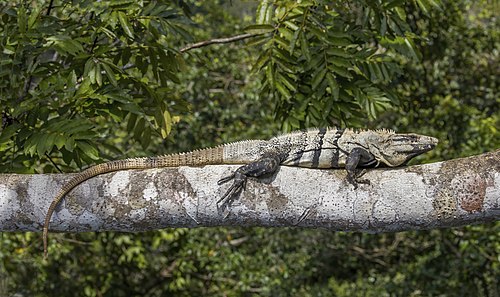
The green iguana (Iguana iguana), also known as the American iguana or the common green iguana, is a large, arboreal, mostly herbivorous species of lizard of the genus Iguana. Usually, this animal is simply called the iguana. The green iguana ranges over a large geographic area; it is native from southern Brazil and Paraguay as far north as Mexico. It is highly invasive in many subtropical and tropical environments throughout the world.
A herbivore, it has adapted significantly with regard to locomotion and osmoregulation as a result of its diet. It grows to 1.7 m (5.6 ft) in length from head to tail, although a few specimens have grown more than 2 m (6.6 ft) with bodyweights upward of 9 kg (20 lb).
Although this species is commonly kept as a pet because of its disposition and coloration, it can be challenging to care for properly. Its requirements for adequate space, lighting, and heat can be difficult for hobbyists to meet.
The species was first officially described by Swedish botanist Carl Linnaeus in 1758. Since then, numerous subspecies have been identified, but later classified as merely regional variants of the same species. Using nuclear and mitochondrial DNA... Wikipedia →
Closest Relatives at Tikal National Park
Global Distribution
Where this species is recorded worldwide. Restricted to human observations from 2019 onwards — the same kind of record and the same period the probabilities on this page are built from, so collar-tracking studies, camera-trap arrays and museum specimens are excluded. Around Santa Rosa that removes 5,924 GPS fixes from a handful of tagged jaguars.
where this species is recorded (GBIF density — it tracks where observers go, not how likely a sighting is) · parks where it occurs — tap a pin for the sighting probability there