


Tropical Mockingbird
Mimus gilvus
- KingdomAnimalia (Animals)
- PhylumChordata (Chordates)
- ClassAves (Birds)
- OrderPasseriformes (Perching Birds)
- FamilyMimidae (Mockingbirds and Thrashers)
- GenusMimus (Typical Mockingbirds)
- SpeciesMimus gilvus (Tropical Mockingbird)
About the Tropical Mockingbird
The tropical mockingbird (Mimus gilvus) is a resident breeding bird from southern Mexico to northern and eastern South America and in the Lesser Antilles and other Caribbean islands. The tropical mockingbird has sometimes been considered conspecific with its closest living relative, the northern mockingbird (Milvus polyglottos) and forms a superspecies with it. The critically endangered Socorro mockingbird (M. graysoni) is also much closer to these two than previously believed.
The tropical mockingbird has these ten subspecies: M. g. gracilis Cabanis, 1851 M. g. leucophaeus Ridgway, 1888 M. g. antillarum Hellmayr & Seilern, 1915 M. g. tobagensis Dalmas, 1900 M. g. rostratus Ridgway, 1884 M. g. melanopterus Lawrence, 1849
M. g. gilvus (Vieillot, 1808) M. g. tolimensis Ridgway, 1904 M. g. antelius Oberholser, 1919 M. g. magnirostris Cory, 1887 M. g. antelius and M. g. magnirostris have been suggested as separate species but morphological and vocal evidence for the potential splits are weak.
Adult tropical mockingbirds are 23 to 25.5 cm (9.1 to 10.0 in) long. The mean weights of various subspecies vary greatly. Adults of the nominate subspecies... Wikipedia →
Closest Relatives at Tikal National Park
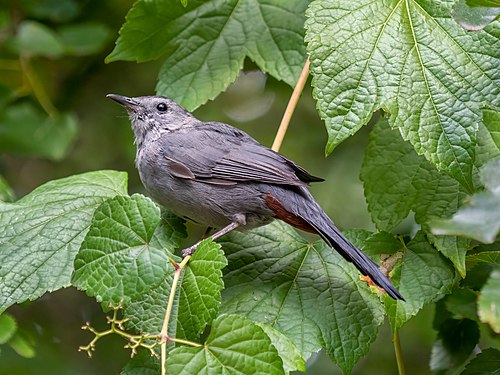
Gray Catbird
Dumetella carolinensis

Black Catbird
Melanoptila glabrirostris

Brown Jay
Psilorhinus morio

Montezuma Oropendola
Psarocolius montezuma

Melodious Blackbird
Dives dives

Social Flycatcher
Myiozetetes similis

Magnolia Warbler
Setophaga magnolia

Lesser Greenlet
Hylophilus decurtatus

Spot-breasted Wren
Pheugopedius maculipectus

Black-and-white Warbler
Mniotilta varia

Masked Tityra
Tityra semifasciata

Wood Thrush
Hylocichla mustelina
Global Distribution
Where this species is recorded worldwide. Restricted to human observations from 2019 onwards — the same kind of record and the same period the probabilities on this page are built from, so collar-tracking studies, camera-trap arrays and museum specimens are excluded. Around Santa Rosa that removes 5,924 GPS fixes from a handful of tagged jaguars.
where this species is recorded (GBIF density — it tracks where observers go, not how likely a sighting is) · parks where it occurs — tap a pin for the sighting probability there