


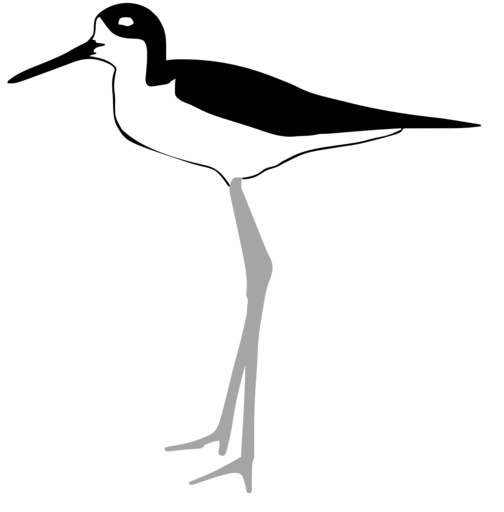
Black-necked Stilt
Himantopus mexicanus
Silhouette: Edwin Price · PhyloPic
- KingdomAnimalia (Animals)
- PhylumChordata (Chordates)
- ClassAves (Birds)
- OrderCharadriiformes (Shorebirds and Allies)
- FamilyRecurvirostridae (Stilts and Avocets)
- GenusHimantopus (Typical Stilts)
- SpeciesHimantopus mexicanus (Black-necked Stilt)
About the Black-necked Stilt
The black-necked stilt (Himantopus mexicanus), also called the pied stilt, is a locally abundant shorebird of North and South American wetlands and coastlines. It is found from the coastal areas of California through much of the interior western United States and along the Gulf of Mexico as far east as Florida, then south through Central America and the Caribbean to Brazil, Peru and the Galápagos Islands, with an isolated population, the Hawaiian stilt, in Hawaii. The northernmost populations, particularly those from inland, are migratory, wintering from the extreme south of the United States to southern Mexico, rarely as far south as Costa Rica; on the Baja California peninsula it is only found regularly in winter. Some authorities, including the IUCN, treat it as a synonym of Himantopus himantopus.
The black-necked stilt was formally described in 1776 as Charadrius mexicanus by the German zoologist Philipp Statius Müller. The species is now placed in the genus Himantopus that was introduced in 1760 by the French ornithologist Mathurin Jacques Brisson.
Three subspecies are recognised: H. m. knudseni Stejneger, LH, 1887 – main Hawaiian Islands H. m. mexicanus (Müller... Wikipedia →
Recent sightings of Black-necked Stilt in Vicente Pérez Rosales National Park
LIVEiNaturalistClosest Relatives at Vicente Pérez Rosales National Park

 Southern Lapwing
Vanellus chilensis

 Dominican Gull
Larus dominicanus

 Brown-hooded Gull
Chroicocephalus maculipennis

 Lesser Yellowlegs
Tringa flavipes

 Gray-breasted Seedsnipe
Thinocorus orbignyianus

 Whimbrel
Numenius phaeopus

 Greater Yellowlegs
Tringa melanoleuca

 Baird's Sandpiper
Calidris bairdii

 Franklin's Gull
Leucophaeus pipixcan

 Magellanic Snipe
Gallinago magellanica
Global Distribution
Warmer areas are where this animal is recorded most often.