



Amazon Kingfisher
Chloroceryle amazona
Silhouette: Steven Traver · PhyloPic
- KingdomAnimalia (Animals)
- PhylumChordata (Chordates)
- ClassAves (Birds)
- OrderCoraciiformes (Rollers, Kingfishers, and Allies)
- FamilyAlcedinidae (Kingfishers)
- GenusChloroceryle (American Green Kingfishers)
- SpeciesChloroceryle amazona (Amazon Kingfisher)
About the Amazon Kingfisher
The Amazon kingfisher (Chloroceryle amazona) is a species of "water kingfisher" in subfamily Cerylinae of family Alcedinidae. It is found in the lowlands of the American tropics from southern Mexico south through Central America to northern Argentina.
The first formal description of the Amazon kingfisher was by the English ornithologist John Latham in 1790 under the binomial name Alcedo amazona. The current genus Chloroceryle was erected by Johann Jakob Kaup in 1848. The species is monotypic.
The Amazon kingfisher is about 30 cm (12 in) long. Males weigh 98 to 121 g (3.5 to 4.3 oz) and females 125 to 140 g (4.4 to 4.9 oz). It has the typical kingfisher shape, with a shaggy crest and long heavy bill. The bill is black with some pale yellow at the base of the mandible and its legs and feet are dark grey. Adult males have dark bronzy green upperparts divided by a white collar. They have a white chin and throat, a rich rufous breast with dark green sides, and a white belly with dark green streaks on the side. Adult females lack the rufous breast but the green of the sides extends across the breast almost to its middle. Juvenile males have... Wikipedia →
Recent sightings of Amazon Kingfisher in Cahuita National Park
LIVEiNaturalistClosest Relatives at Cahuita National Park

 Green Kingfisher
Chloroceryle americana

American Pygmy Kingfisher
Chloroceryle aenea
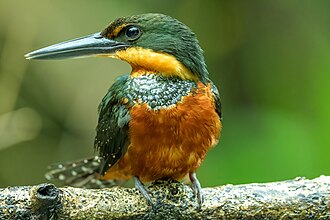
Green-and-rufous Kingfisher
Chloroceryle inda

 Ringed Kingfisher
Megaceryle torquata

Belted Kingfisher
Megaceryle alcyon

 Broad-billed Motmot
Electron platyrhynchum

Rufous Motmot
Baryphthengus martii
Global Distribution
Warmer areas are where this animal is recorded most often.
Parks Where Found
Quick answers
What are the chances of seeing a Amazon Kingfisher in Cahuita National Park?
Under 5% of wildlife watchers report a Amazon Kingfisher sighting in Cahuita National Park, based on 21 verified sightings from GBIF citizen-science data.
When is the best time to see Amazon Kingfisher in Cahuita National Park?
July has the highest sighting rate for Amazon Kingfisher in Cahuita National Park in our monthly data.