



Tropical House Gecko
Hemidactylus mabouia
Silhouette: Andy Wilson · PhyloPic
- KingdomAnimalia (Animals)
- PhylumChordata (Chordates)
- ClassSquamata
- FamilyGekkonidae (Typical Geckos)
- GenusHemidactylus (House Geckos)
- SpeciesHemidactylus mabouia (Tropical House Gecko)
About the Tropical House Gecko
The tropical house gecko (Hemidactylus mabouia), also called the cosmopolitan house gecko, is a species of lizard in the family Gekkonidae. The species is native to sub-Saharan Africa. However, it is also found in North, Central and South America and the Caribbean, where it has been inadvertently introduced by humans.
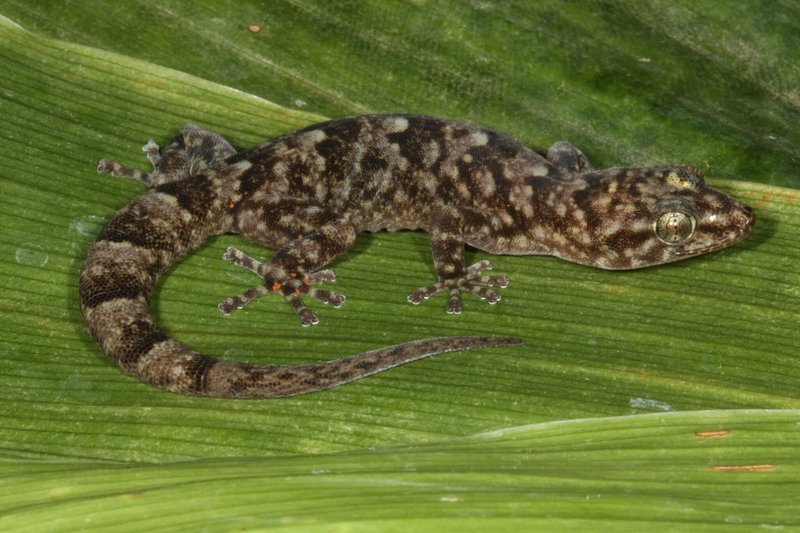
The tropical house gecko has an average total length of 10–12.7 centimetres (3.9–5.0 in) (including tail) and an average mass of 4.6 grams (0.16 oz). Females are on average somewhat larger than males, with the male average snout-to-vent length (SVL) being 51.56 mm (2.030 in) and the female average SVL being 54.47 mm (2.144 in). Normally coloured in black and brown bands, this gecko can slowly change its colour based on its ambient temperature and lighting; its scales vary in colour from dark brown to light grey. The tropical house gecko bears particularly scaly lamellae on the underside of its toes, enabling it to grip onto vertical surfaces.
The diet of H. mabouia is varied, and includes animals such as isopods, centipedes, spiders, scorpions, cockroaches, beetles, moths, flies, mosquitoes, snails, slugs, frogs, anoles, other geckos and blind... Wikipedia →
Recent sightings of Tropical House Gecko in Kruger National Park
LIVEiNaturalistClosest Relatives at Kruger National Park

 Cape Dwarf Gecko
Lygodactylus capensis

 Turner's Thick-toed Gecko
Chondrodactylus turneri

 Wahlberg's Velvet Gecko
Homopholis wahlbergii

 Pointed Thick-toed Gecko
Pachydactylus punctatus

 Haacke's Flat Gecko
Afroedura haackei

Stevenson's Dwarf Gecko
Lygodactylus stevensoni

Arnold's Velvet Gecko
Homopholis arnoldi

Van Son's Thick-toed Gecko
Pachydactylus vansoni

Spotted Thick-toed Gecko
Pachydactylus maculatus
Granite Rock Gecko
Afroedura granitica

Lang's Flat Gecko
Afroedura langi
Global Distribution
Warmer areas are where this animal is recorded most often.
Parks Where Found
Quick answers
What are the chances of seeing a Tropical House Gecko in Kruger National Park?
About 30% of wildlife watchers report a Tropical House Gecko sighting in Kruger National Park, based on 477 verified sightings from GBIF citizen-science data.
When is the best time to see Tropical House Gecko in Kruger National Park?
February has the highest sighting rate for Tropical House Gecko in Kruger National Park in our monthly data.