


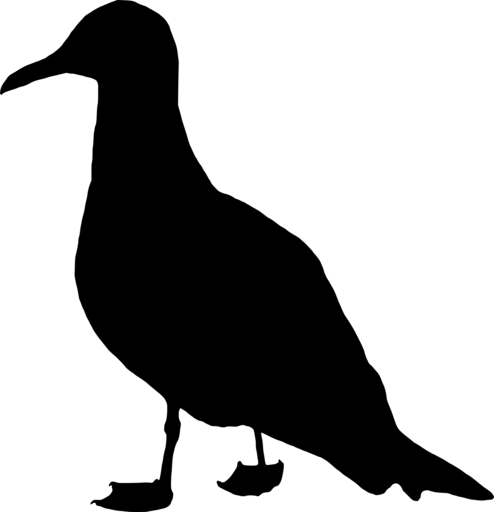
Laughing Gull
Leucophaeus atricilla
Silhouette: Kai Caspar · PhyloPic
- KingdomAnimalia (Animals)
- PhylumChordata (Chordates)
- ClassAves (Birds)
- OrderCharadriiformes (Shorebirds and Allies)
- FamilyLaridae (Gulls, Terns, and Skimmers)
- GenusLeucophaeus (Hooded Gulls)
- SpeciesLeucophaeus atricilla (Laughing Gull)
About the Laughing Gull
The laughing gull (Leucophaeus atricilla) is a medium-sized gull of North and South America. Named from its laugh-like call, it is an opportunistic omnivore and scavenger. It breeds in large colonies mostly along the Atlantic coast of North America, the Caribbean, and northern South America. Two subspecies are accepted, L. a. atricilla, which occurs from the West Indies to the Venezuelan islands, and L. a. megalopterus, which occurs from southeast Canada down to Central America. The laughing gull was long placed in the genus Larus until its present placement in Leucophaeus.
The laughing gull was formally described in 1758 by the Swedish naturalist Carl Linnaeus in the tenth edition of his Systema Naturae under the binomial name Larus atricilla. Linnaeus based his account on the "laughing gull" from the Bahamas that had been described and illustrated in 1729–1732 by the English naturalist Mark Catesby in his The Natural History of Carolina, Florida and the Bahama Islands. The laughing gull is now one of five New World gulls placed in the genus Leucophaeus that was introduced in 1855 by the German ornithologist Carl Friedrich Bruch. The genus name Leucophaeus is from Ancient... Wikipedia →
Recent sightings of Laughing Gull in Point Pelee National Park
LIVEiNaturalistClosest Relatives at Point Pelee National Park

 Franklin's Gull
Leucophaeus pipixcan

 Ring-billed Gull
Larus delawarensis

 American Herring Gull
Larus smithsonianus

 Bonaparte's Gull
Chroicocephalus philadelphia

 Common Tern
Sterna hirundo

 Great Black-backed Gull
Larus marinus

 Black Tern
Chlidonias niger

 Lesser Black-backed Gull
Larus fuscus

 Caspian Tern
Hydroprogne caspia

Forster's Tern
Sterna forsteri

 Black-headed Gull
Chroicocephalus ridibundus

 Little Gull
Hydrocoloeus minutus
Global Distribution
Warmer areas are where this animal is recorded most often.