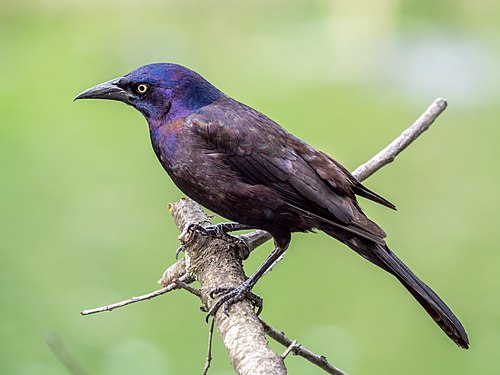
Great-tailed Grackle

Great-tailed Grackle

Quiscalus mexicanus

Least ConcernNear ThreatenedVulnerableEndangeredCritically Endangered Endemic
Daily sighting probability ~30% · Possible
at Saguaro National Park
15,743 Verified sightings at Saguaro National Park From 2019 to 2026
68,402 Verified sightings across all 72 parks From 2019 to 2026
May Best month highest sighting rate
☀️ Diurnal When it's spotted during daytime hours (6am–6pm)

About the Great-tailed Grackle

The great-tailed grackle or Mexican grackle (Quiscalus mexicanus) is a medium-sized, highly social passerine bird native to North and South America. A member of the family Icteridae, it is one of 10 extant species of grackle and is closely related to the boat-tailed grackle and the extinct slender-billed grackle. In the southern and southwestern United States, the grackle is sometimes referred to simply as a "blackbird" or (erroneously) a "crow" due to its glossy black plumage; however, grackles form their own unique genus that is separate from other "blackbirds", such as the red-winged and Brewer's blackbirds, despite being in the same family (Icteridae). Superficially, Brewer's blackbird is one of the most visually similar species to grackles.

In some parts of Mexico, the grackle is sometimes referred to in Spanish as cuervo ("raven"; "crow"), although it is not a member of the crow genus (Corvus) nor of their family (Corvidae). The great-tailed grackle was formally described in 1788 by the German naturalist Johann Friedrich Gmelin in his revised and expanded edition of Carl Linnaeus's Systema Naturae. He placed it with the crows in the genus Corvus and coined the... Wikipedia →

Global Distribution

Where this species is recorded worldwide. Restricted to human observations from 2019 onwards — the same kind of record and the same period the probabilities on this page are built from, so collar-tracking studies, camera-trap arrays and museum specimens are excluded. Around Santa Rosa that removes 5,924 GPS fixes from a handful of tagged jaguars.

where this species is recorded (GBIF density — it tracks where observers go, not how likely a sighting is)  ·  parks where it occurs — tap a pin for the sighting probability there

Parks Where Found

# Park Country Daily sighting probability
1 Arrecifes de Cozumel National Park 🇲🇽 Mexico
~80%
2 Las Baulas Marine National Park 🇨🇷 Costa Rica
~80%
3 Sian Ka'an Biosphere Reserve 🇲🇽 Mexico
~80%
4 Lago de Yojoa 🇭🇳 Honduras
~80%
5 Cañón del Sumidero National Park 🇲🇽 Mexico
~70%
6 Ostional Wildlife Refuge 🇨🇷 Costa Rica
~60%
7 Manuel Antonio National Park 🇨🇷 Costa Rica
~60%
8 Celestún Biosphere Reserve 🇲🇽 Mexico
~60%
9 Tortuguero National Park 🇨🇷 Costa Rica
~60%
10 Utría National Natural Park 🇨🇴 Colombia
~60%
11 Ría Lagartos Biosphere Reserve 🇲🇽 Mexico
~60%
12 Marino Ballena National Park 🇨🇷 Costa Rica
~60%
13 Cerro Azul Meámbar National Park 🇭🇳 Honduras
~50%
14 Coiba National Park 🇵🇦 Panama
~50%
15 Monteverde Cloud Forest Reserve 🇨🇷 Costa Rica
~50%
16 Masaya Volcano National Park 🇳🇮 Nicaragua
~50%
17 Celaque National Park 🇭🇳 Honduras
~40%
18 Rincón de la Vieja National Park 🇨🇷 Costa Rica
~40%
19 Piedras Blancas National Park 🇨🇷 Costa Rica
~40%
20 Tayrona National Natural Park 🇨🇴 Colombia
~40%
21 San Lorenzo Protected Forest 🇵🇦 Panama
~40%
22 Palo Verde National Park 🇨🇷 Costa Rica
~40%
23 Pico Bonito National Park 🇭🇳 Honduras
~40%
24 Cabo Blanco Absolute Nature Reserve 🇨🇷 Costa Rica
~40%
25 Cahuita National Park 🇨🇷 Costa Rica
~40%
26 La Amistad International Park (Panama) 🇵🇦 Panama
~30%
27 Biotopo Cerro Cahuí 🇬🇹 Guatemala
~30%
28 El Triunfo 🇲🇽 Mexico
~30%
29 La Tigra National Park 🇭🇳 Honduras
~30%
30 Gandoca-Manzanillo Wildlife Refuge 🇨🇷 Costa Rica
~30%
31 Calakmul Biosphere Reserve 🇲🇽 Mexico
~30%
32 Saguaro National Park 🇺🇸 United States
~30%
33 Irazú Volcano National Park 🇨🇷 Costa Rica
~30%
34 Bastimentos Island National Marine Park 🇵🇦 Panama
~30%
35 Montes Azules Biosphere Reserve 🇲🇽 Mexico
~30%
36 Volcán Barú National Park 🇵🇦 Panama
~30%
37 Soberanía National Park 🇵🇦 Panama
~30%
38 Death Valley National Park 🇺🇸 United States
~30%
39 Darién National Park 🇵🇦 Panama
~20%
40 Santa Rosa National Park 🇨🇷 Costa Rica
~20%
41 Channel Islands National Park 🇺🇸 United States
~20%
42 Carara National Park 🇨🇷 Costa Rica
~20%
43 Poás Volcano National Park 🇨🇷 Costa Rica
~20%
44 Braulio Carrillo National Park 🇨🇷 Costa Rica
~20%
45 Tikal National Park 🇬🇹 Guatemala
~20%
46 Corcovado National Park 🇨🇷 Costa Rica
~20%
47 Arenal Volcano National Park 🇨🇷 Costa Rica
~20%
48 Tenorio Volcano National Park 🇨🇷 Costa Rica
~20%
49 Parque Natural Metropolitano 🇵🇦 Panama
~10%
50 Reserva de la Biosfera Mariposa Monarca 🇲🇽 Mexico
~10%
51 Cusuco National Park 🇭🇳 Honduras
~10%
52 Joshua Tree National Park 🇺🇸 United States
~10%
53 Chagres National Park 🇵🇦 Panama
~10%
54 Cockscomb Basin Wildlife Sanctuary 🇧🇿 Belize
~10%
55 Tapantí-Macizo de la Muerte National Park 🇨🇷 Costa Rica
~10%
56 El Vizcaíno Biosphere Reserve 🇲🇽 Mexico
~10%
57 Big Bend National Park 🇺🇸 United States
~10%
58 Grand Canyon National Park 🇺🇸 United States
~10%
59 Chirripó National Park 🇨🇷 Costa Rica
<5%
60 Zion National Park 🇺🇸 United States
<5%
61 Sequoia and Kings Canyon National Parks 🇺🇸 United States
<5%
62 Puracé National Natural Park 🇨🇴 Colombia
<5%
63 Yosemite National Park 🇺🇸 United States
<5%
64 Los Quetzales National Park 🇨🇷 Costa Rica
<5%
65 Los Nevados National Natural Park 🇨🇴 Colombia
<5%
66 Rocky Mountain National Park 🇺🇸 United States
<5%
67 Badlands National Park 🇺🇸 United States
Insufficient data
68 Guadalupe Mountains National Park 🇺🇸 United States
Insufficient data
69 Machalilla National Park 🇪🇨 Ecuador
Insufficient data
70 Everglades National Park 🇺🇸 United States
Insufficient data
71 Farallones de Cali National Natural Park 🇨🇴 Colombia
Insufficient data
72 Galápagos Islands 🇪🇨 Ecuador
Insufficient data

Quick answers

What are the chances of seeing a Great-tailed Grackle in Saguaro National Park?

About 30% of wildlife watchers report a Great-tailed Grackle sighting in Saguaro National Park, based on 15,743 verified sightings from GBIF citizen-science data.

When is the best time to see Great-tailed Grackle in Saguaro National Park?

May has the highest sighting rate for Great-tailed Grackle in Saguaro National Park in our monthly data.

← Back to Saguaro National Park