


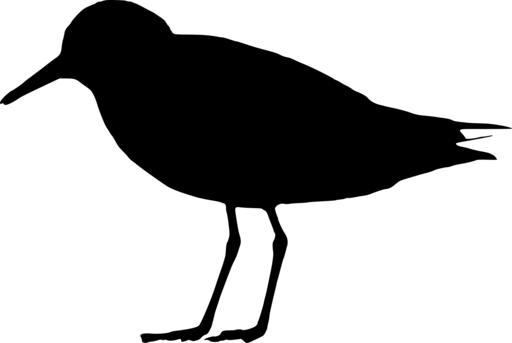
Sanderling
Calidris alba
Silhouette: Caleb M. Gordon · PhyloPic
- KingdomAnimalia (Animals)
- PhylumChordata (Chordates)
- ClassAves (Birds)
- OrderCharadriiformes (Shorebirds and Allies)
- FamilyScolopacidae (Sandpipers and Allies)
- GenusCalidris (Calidris Sandpipers)
- SpeciesCalidris alba (Sanderling)
About the Sanderling
The sanderling (Calidris alba) is a small wading bird. It is a circumpolar Arctic breeder, being among the most extreme northern breeding birds in the world, nesting only on the coldest tundra, north of the 5°C July isotherm; in Europe, its southernmost breeding locality is Svalbard, where only a handful (5–15) pairs breed. It is a long-distance migrant, wintering south to South America, western and southern Europe, Africa, and Australia. It is highly gregarious in winter, sometimes forming large flocks on coastal mudflats or sandy beaches.
It is somewhat unlike other small sandpipers in appearance, in particular in lacking a hind toe, which has led to the suggestion that it should be placed into a monotypic genus Crocethia. More recent reviews indicate that the sanderling is a fairly typical "stint" or small sandpiper and should be retained along with the knots and other relatives in the genus Calidris.
This bird is similar in size to a dunlin, but stouter, with a thick bill. It shows a strong white wingbar in flight, and runs along the sandy beaches it prefers with a characteristic "bicycling" action of its legs, stopping frequently to pick small food items. It eats small crabs and other small invertebrates. In spring, birds migrating north from South America consume large numbers of horseshoe crab eggs in the Delaware Bay area.
In spring, the birds arrive on their High Arctic breeding grounds (see map) at the end of May or in early June, where they lay 3–4 eggs in a ground scrape from mid June to mid July. On the nesting grounds, these birds mainly eat insects and some plant material.
The sanderling was described by the German naturalist Peter Simon Pallas in 1764 and given the binomial name Trynga alba. The sanderling is one of the species to which the Agreement on the Conservation of African-Eurasian Migratory Waterbirds (AEWA) applies. Wikipedia →
Recent sightings of Sanderling in Tayrona National Natural Park
LIVEiNaturalistClosest Relatives at Tayrona National Natural Park

 Least Sandpiper
Calidris minutilla

 Red Knot
Calidris canutus

Pectoral Sandpiper
Calidris melanotos

 Spotted Sandpiper
Actitis macularius

 Hudsonian Whimbrel
Numenius hudsonicus

 Solitary Sandpiper
Tringa solitaria

 Greater Yellowlegs
Tringa melanoleuca

 Willet
Tringa semipalmata

 Whimbrel
Numenius phaeopus

Lesser Yellowlegs
Tringa flavipes

 Royal Tern
Thalasseus maximus

 Southern Lapwing
Vanellus chilensis
Global Distribution
Warmer areas are where this animal is recorded most often.
Parks Where Found
Quick answers
What are the chances of seeing a Sanderling in Tayrona National Natural Park?
Under 5% of wildlife watchers report a Sanderling sighting in Tayrona National Natural Park, based on 20 verified sightings from GBIF citizen-science data.
When is the best time to see Sanderling in Tayrona National Natural Park?
November has the highest sighting rate for Sanderling in Tayrona National Natural Park in our monthly data.