


Wood Sandpiper
Tringa glareola
- KingdomAnimalia (Animals)
- PhylumChordata (Chordates)
- ClassAves (Birds)
- OrderCharadriiformes (Shorebirds and Allies)
- FamilyScolopacidae (Sandpipers and Allies)
- GenusTringa (Shanks, Tattlers, and Allies)
- SpeciesTringa glareola (Wood Sandpiper)
About the Wood Sandpiper
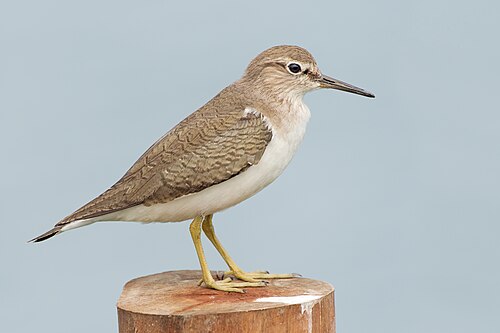
The wood sandpiper (Tringa glareola) is a small wader belonging to the sandpiper family Scolopacidae. A Eurasian species, it is the smallest of the shanks, a genus of mid-sized, long-legged waders that largely inhabit freshwater and wetland environments, as opposed to the maritime or coastal habitats of other, similar species.
The wood sandpiper was formally described in 1758 by the Swedish naturalist Carl Linnaeus in the tenth edition of his Systema Naturae under the current binomial name Tringa glareola. Linnaeus cited his own Fauna Svecica that had been published in 1746. He specified the type locality as Europe but it is now restricted to Sweden. The species is considered to be monotypic: no subspecies are recognised. The genus name, Tringa, is the Neo-Latin name given to the green sandpiper (Tringa ochropus) in 1599 by Aldrovandus, based on the Ancient Greek trungas, a "thrush-sized, white-rumped, tail-bobbing" wading bird mentioned by Aristotle. The specific glareola is from the Latin glarea, meaning "gravel".
The wood sandpiper resembles a longer-legged, more delicate form of the aforementioned green sandpiper (T. ochropus), or a solitary sandpiper... Wikipedia →
Closest Relatives at Manas National Park

Green Sandpiper
Tringa ochropus

Common Greenshank
Tringa nebularia

Common Redshank
Tringa totanus

Marsh Sandpiper
Tringa stagnatilis

Spotted Redshank
Tringa erythropus
Common Sandpiper
Actitis hypoleucos

Common Snipe
Gallinago gallinago

Temminck's Stint
Calidris temminckii

Pin-tailed Snipe
Gallinago stenura

Ruff
Calidris pugnax

Red-wattled Lapwing
Vanellus indicus

River Lapwing
Vanellus duvaucelii
Global Distribution
Where this species is recorded worldwide. Restricted to human observations from 2019 onwards — the same kind of record and the same period the probabilities on this page are built from, so collar-tracking studies, camera-trap arrays and museum specimens are excluded. Around Santa Rosa that removes 5,924 GPS fixes from a handful of tagged jaguars.
where this species is recorded (GBIF density — it tracks where observers go, not how likely a sighting is) · parks where it occurs — tap a pin for the sighting probability there
Parks Where Found
Quick answers
What are the chances of seeing a Wood Sandpiper in Manas National Park?
Under 5% of wildlife watchers report a Wood Sandpiper sighting in Manas National Park, based on 5 verified sightings from GBIF citizen-science data.
When is the best time to see Wood Sandpiper in Manas National Park?
March has the highest sighting rate for Wood Sandpiper in Manas National Park in our monthly data.