



Green Kingfisher
Chloroceryle americana
Silhouette: Steven Traver · PhyloPic
- KingdomAnimalia (Animals)
- PhylumChordata (Chordates)
- ClassAves (Birds)
- OrderCoraciiformes (Rollers, Kingfishers, and Allies)
- FamilyAlcedinidae (Kingfishers)
- GenusChloroceryle (American Green Kingfishers)
- SpeciesChloroceryle americana (Green Kingfisher)
About the Green Kingfisher
The green kingfisher (Chloroceryle americana) is a species of "water kingfisher" in the subfamily Cerylinae of the family Alcedinidae. It is found from southern Texas in the United States south through Central America, and in every mainland South American country except Chile.
The green kingfisher was formally described in 1788 by the German naturalist Johann Friedrich Gmelin in his revised and expanded edition of Carl Linnaeus's Systema Naturae. He placed it with the other kingfishers in the genus Alcedo and coined the binomial name Alcedo americana. Gmelin based his description on "Le martin-pêcheur vert et blanc" from Cayenne that had been described and illustrated in 1780 by the French polymath Comte de Buffon and also the "white and green kingfisher" that had been described in 1782 by the English ornithologist John Latham. The green kingfisher is now placed in the genus Chloroceryle that was introduced in 1848 by Johann Jakob Kaup.
A molecular phylogenetic study published in 2006 found that the green kingfisher is a sister species to the larger green-and-rufous kingfisher (C. inda). Five subspecies are recognized: Some populations of C. a. septentrionalis... Wikipedia →
Recent sightings of Green Kingfisher in Tambopata National Reserve
LIVEiNaturalistClosest Relatives at Tambopata National Reserve

 Amazon Kingfisher
Chloroceryle amazona

American Pygmy Kingfisher
Chloroceryle aenea
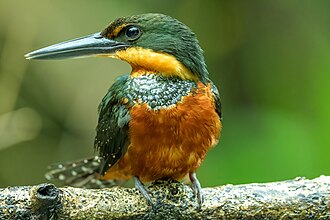
Green-and-rufous Kingfisher
Chloroceryle inda

 Ringed Kingfisher
Megaceryle torquata

 Amazonian Motmot
Momotus momota

Broad-billed Motmot
Electron platyrhynchum

Rufous Motmot
Baryphthengus martii

Andean Motmot
Momotus aequatorialis
Global Distribution
Warmer areas are where this animal is recorded most often.
Parks Where Found
Quick answers
What are the chances of seeing a Green Kingfisher in Tambopata National Reserve?
About 10% of wildlife watchers report a Green Kingfisher sighting in Tambopata National Reserve, based on 258 verified sightings from GBIF citizen-science data.
When is the best time to see Green Kingfisher in Tambopata National Reserve?
April has the highest sighting rate for Green Kingfisher in Tambopata National Reserve in our monthly data.