


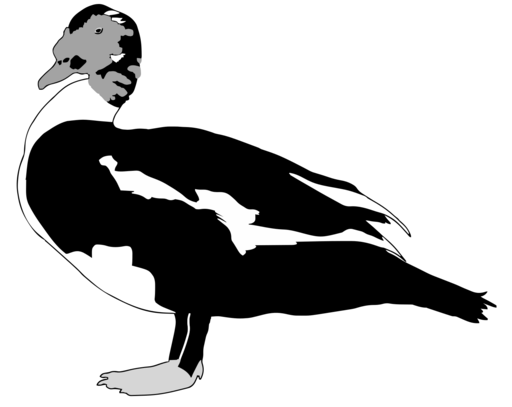
Muscovy Duck
Cairina moschata
Silhouette: Edwin Price · PhyloPic
- KingdomAnimalia (Animals)
- PhylumChordata (Chordates)
- ClassAves (Birds)
- OrderAnseriformes (Waterfowl)
- FamilyAnatidae (Ducks, Geese, and Swans)
- GenusCairina (Muscovy Ducks)
- SpeciesCairina moschata (Muscovy Duck)
About the Muscovy Duck
The Muscovy duck (Cairina moschata) is a species of duck native to the Americas, from the Lower Rio Grande Valley of Texas and Mexico south to Argentina and Uruguay. The species has been domesticated, and feral Muscovy ducks can be found locally in New Zealand, Australia, the United States, and in Central and Eastern Europe.
It is a large duck, with the males significantly larger than the females. The males are 76–84 cm (30–33 in) long and weigh up to 3–4 kg (6.6–8.8 lb); females are 71–76 cm (28–30 in) long and 1.25 kg (2.8 lb) weight, roughly half the weight of the males. The wingspan is from 137 to 152 cm (54 to 60 in). The plumage is predominantly black, with large white patches on the wing; the back and wing feathers being iridescent and glossy in males, while the females are more drab. Muscovy ducks have long claws on their feet and a wide, flat tail.
On the head, the male has a short crest on the nape. The bill is black with a speckling of pale pink. A blackish or dark red knob can be seen at the bill base, which is similar in colour to the bare skin of the face. The eyes are yellowish-brown. The legs and webbed feet are blackish. The female is similar in plumage... Wikipedia →
Recent sightings of Muscovy Duck in Joshua Tree National Park
LIVEiNaturalistClosest Relatives at Joshua Tree National Park

 Mallard
Anas platyrhynchos

 Canada Goose
Branta canadensis

 American Wigeon
Mareca americana

Ruddy Duck
Oxyura jamaicensis

 Ring-necked Duck
Aythya collaris

 Northern Shoveler
Spatula clypeata

Cinnamon Teal
Spatula cyanoptera

 Eurasian Wigeon
Mareca penelope

 Canvasback
Aythya valisineria

 Mute Swan
Cygnus olor

 Lesser Scaup
Aythya affinis

 Gadwall
Mareca strepera
Global Distribution
Warmer areas are where this animal is recorded most often.
Parks Where Found
Quick answers
What are the chances of seeing a Muscovy Duck in Joshua Tree National Park?
Under 5% of wildlife watchers report a Muscovy Duck sighting in Joshua Tree National Park, based on 93 verified sightings from GBIF citizen-science data.
When is the best time to see Muscovy Duck in Joshua Tree National Park?
January has the highest sighting rate for Muscovy Duck in Joshua Tree National Park in our monthly data.